
The Old Leatherman in the late 1880s. Credit…From the Connecticut Museum of Culture and History
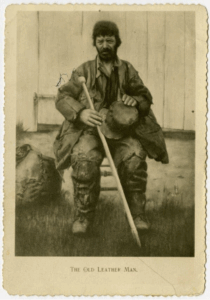 As residents compared notes, as newspaper coverage snowballed, some actual facts became clear. For one thing, it turned out that the Old Leatherman was traveling great distances. His network of caves spanned at least 100 miles. Also, his wanderings weren’t random — they were regular and repetitive. In an effort to map his route, people set up sting operations in the woods; they tailed him from town to town.
Mid-1880s, The Old Leatherman was walking in a giant loop, roughly 365 miles around. It stretched from the Hudson River in the west to the Connecticut River in the east, from mountains in the north to beaches in the south. He passed through 50 towns. One full circuit usually took him 34 days. “His coming can be calculated with almost as much certainty as that of an eclipse,” one newspaper wrote. Another said, “So regular are his habits that it is often said that he is the only sure thing that farmers can depend upon in this age of uncertainty.”
Soon, the Old Leatherman became a full-blown media phenomenon. The Hartford Globe published a front-page article complete with a timetable of his travels. In small towns, people lined the streets to watch him pass. Schoolteachers let their students out of class to give him treats. A shop offered promotional Old Leatherman postcards. Artists produced woodcuts and paintings. Photographers hid cameras in doorways, or behind hanging laundry, to capture his image.
The Old Leatherman never sought the attention. If anything, he avoided it. He went out of his way to skirt the region’s big cities — Hartford, Bridgeport, New Haven — and if a homeowner got too inquisitive, he would walk away and never come back. Once, in Woodbury, Conn., someone presented the Old Leatherman with some recent articles about him. “He grunted over them,” the newspaper account read, “but showed no enthusiasm at finding himself famous.”
“One of the most noted philologists in the State spoke to him in a half-dozen different languages,” The New York Times reported in 1884. “He could get no reply but a guttural sound which meant nothing, and which was more animal than human in its character.”